
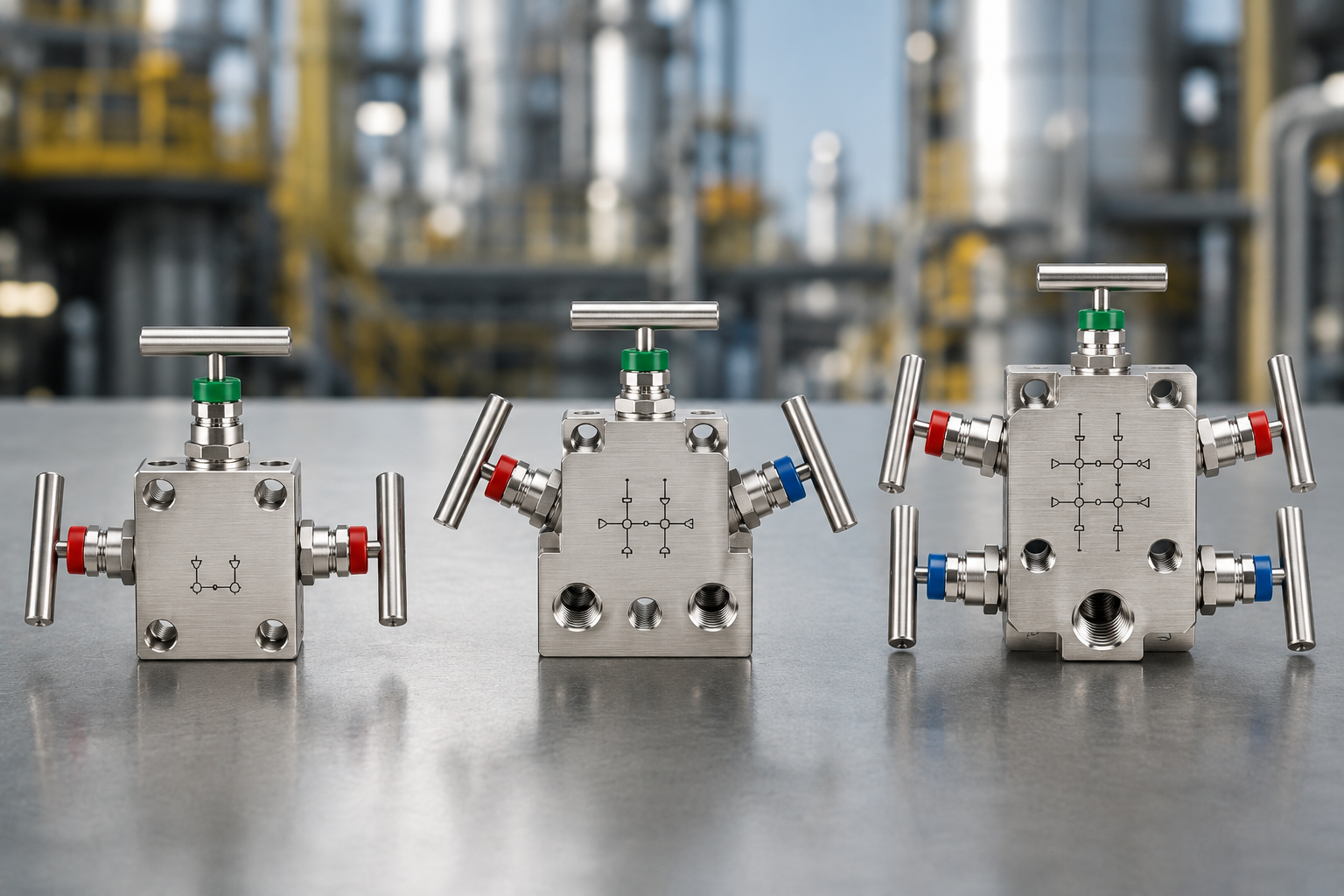
Accurate pressure measurement and effective instrument management are critical for safe and reliable operation of the industrial process system. A manifold valve is an essential part of an instrumentation setup, offering multiple functions of isolation, pressure control, equalization and venting in a compact assembly.
Instrumentation Manifolds are employed in various industries to enhance the efficiency of the system and ease maintenance tasks like oil & gas, chemical processing, power plants, refineries, manufacturing, etc. But, the selection of the correct manifold configuration can be tricky, particularly between Manifold 2 Way, Manifold 3 Way and Manifold 5 Way manifold designs.
Every configuration suits a particular application and knowing the differences can help engineers choose which configuration is appropriate for their instrumentation needs. Precision engineered manifold solutions from Wesmec Engineering are engineered to provide reliability, safety and long-term performance in challenging industrial environments.
What Are Instrumentation Manifolds?
The Instrumentation Manifolds are valve assemblies designed to link the process lines with the measuring instruments like pressure gauges, pressure transmitters and differential pressure transmitters. They combine several valve functions into a single integrated unit, which saves space and facilitates operation control.
Multiple valves, fittings and connections are likely to be needed with traditional instrumentation configurations. A manifold can make this easier, as a single assembly that includes all of these.
Some of the key benefits of using manifold valves are
- Improved instrument isolation
- Reduced chances of leakage
- Compact installation design
- Easier maintenance and calibration
- Better process safety
Manifolds can be used in a variety of forms, as two-way, three-way and five-way..
What Is a 2-Way Manifold Valve?
A manifold 2-way is the simplest and most commonly used configuration for basic pressure measurement applications. Typically comprised of two valves, which enable the instrument to be separated from the process line.
This type of manifold is primarily employed where the application is used to provide isolation only and not other features such as pressure balancing or venting.
Common Applications of 2-Way Manifold Valves:
- Pressure transmitters
- Pressure gauges
- Process monitoring systems
- General industrial measurement applications
Benefits of 2-Way Manifold Valves:
- Simple operation
- Easy installation
- Lower maintenance requirements
- Cost-effective solution
Manifold 2 Way is suitable for applications where instrument protection and isolation is the main requirement.
What Is a 3-Way Manifold Valve?
A manifold 3-way offers more functions than a 2-way design. The valve is primarily employed in differential pressure measurement systems that need pressure balance on either side of an instrument.
A standard 3-way manifold consists of two isolation valves and one equalizing valve. Equaling valve is used by the technician to balance the pressure before maintenance or calibration is performed.
Common Applications of 3-Way Manifold Valves:
- Differential pressure transmitters
- Flow measurement systems
- Level measurement applications
- Industrial process control systems.
Benefits of 3-Way Manifold Valves:
- Allows pressure equalization
- Protects sensitive instruments
- Improves measurement accuracy
- Simplifies maintenance procedures
In situations where differential pressure measurement is a critical piece to process monitoring, a Manifold 3 Way is typically preferred.In high-pressure processing environments, the right choice of PRV (Pressure Relief Valves) is crucial.
What Is a 5-Way Manifold Valve?
Manifold 5 Way is designed for more advanced instrumentation applications where isolation, equalization and venting is required.
This combination usually consists of two isolation valves, one equalizing valve, and two vent valves. It enables the operator to isolate the instrument, equalize pressure and release trapped pressure during maintenance or calibration in a safe manner.
Common Applications of 5-Way Manifold Valves:
- Differential pressure transmitters
- Flow control systems
- Process automation systems
- High-pressure industrial applications
Benefits of 5-Way Manifold Valves:
- Complete instrument control
- Simple calibration & test procedure.
- Improved operational safety
- Reduced maintenance downtime
The Manifold 5 Way offers more flexibility in complex process applications than simpler manifold valves designs.
Difference Between 2-Way, 3-Way and 5-Way Manifold Valves
The main difference between these manifold configurations is the number of functions they provide.
The 2-Way Manifold is used primarily for isolation. It is suitable for applications with a simple pressure measurement without additional control
For differential pressure instruments where pressure balance is required, a 3-way manifold can be used, as it also incorporates an equalizing action.
A 5-way manifold gives the maximum level of function, as it can isolate, equalize and vent all in a single package. It is appropriate where calibration, testing and maintenance are necessary frequently, e.g., in industry.
The following are some of the factors involved in choosing the right manifold valves :
- Type of instrument to be installed
- Process pressure requirements
- Maintenance frequency
- Required safety features
- Application complexity
Read this article to learn about some of the best things to keep in mind when choosing a manifold valve.
Factors to Consider Before Selecting a Manifold Valve
1. Type of Measurement Application
The first step in determining direct pressure or differential pressure is to find out which type of pressure is being used. Direct pressure systems are typically less complicated and differential pressure systems may need three way and/or five way manifolds.
2. Operating Pressure and Temperature
The chosen manifold should be able to sustain the operating conditions of the system. Material compatibility and pressure ratings are important factors for ensuring reliable performance.
3. Maintenance and Calibration Needs
When regular testing and calibration of instruments is needed, a five-way configuration can offer simpler maintenance accessibilities and control.
4. Space and Installation Requirements
Compact manifold designs: Reduce piping complexity and ease of installation, particularly in space-constrained systems.
Why Choose Wesmec Engineering Manifold Solutions?
Wesmec Engineering is a reliable supplier of industrial instrumentation components, solutions which are built to be accurate, durable and safe.
The company’s range of instrumentation manifolds are designed to suit the needs of many industrial applications and are designed to perform reliably in challenging process conditions.
Producing quality and precision, Wesmec is able to offer manifold solutions to the industries that want to reduce the measurement error, facilitate the maintenance and increase the efficiency of production.
Conclusion
Depending on the instrumentation system requirements the selection of a Manifold 2 Way, Manifold 3 Way and Manifold 5 Way is dependent.
A two-way manifold is an economical option for simple isolation. A three-way manifold gives a better control for differential pressure measurement as it provides pressure equalization. A 5 way manifold is the most thorough solution for advanced industrial applications that require isolation, calibration and venting.
Industries can choose the appropriate manifold valves configuration for their applications, based on its functions, to enhance overall system performance, safety and to ensure reliability. Businesses can have efficient and reliable process operations with the use of advanced instrumentation solutions from Wesmec Engineering.